

Explore our exciting job openings and become part of the team.

Our proud journey from a handcrafted chimney fan in Sorø to a global market leader with a focus on the green transition.

Dealer portal for existing dealers and partners.

Find your nearest dealer.

Inspiration, tips and tricks for your wood-burning stove and a healthier indoor climate.

CAREER

Your career.
Optimized.

Join Exodraft and our shared
ambition to build the bridge to a CO₂-neutral
future with greener energy for everyone.

2026 Top Energy Industry Trends for Global Buyers

Global buyers entering 2026 face an energy industry shaped by rising electricity demand, rapid renewable deployment, and pressure on aging grids. The International Energy Agency (IEA) expects global electricity demand to grow by close to 4% annually through 2027. Data centres, industrial activity, electric vehicles, and cooling needs all contribute. For procurement teams, that growth means more attention to power availability, contract flexibility, and delivery timelines.

The supply picture is changing quickly. The IEA’s Renewables 2024 report forecasts nearly 5,500 gigawatts of new renewable capacity worldwide between 2024 and 2030. Renewables could provide almost half of global electricity generation by the end of that period. Meanwhile, the IEA’s World Energy Investment 2024 report estimated that clean-energy investment would reach about $2 trillion in 2024, roughly twice investment in fossil fuels. These figures signal momentum, not certainty. Project delays, financing costs, and local grid constraints can still alter what buyers receive and when.

Grid readiness matters. The IEA has said annual grid investment needs to rise above $600 billion by 2030 to support secure transitions. A low quoted generation price is therefore only part of the decision. Buyers should also examine connection capacity, storage options, supplier track records, and exposure to price volatility. The data is encouraging, but forecasts are not guarantees. That distinction deserves more attention than it often gets.
2026 Top Energy Industry Trends for Global Buyers

Understanding the Global Energy Landscape in 2026

Global energy markets in 2026 are shaped by rising electricity demand, expanding renewables, and uneven grid readiness. The International Energy Agency’s Electricity 2025 report projects global electricity demand growth of 3.3% in 2025 and 3.7% in 2026. That growth reaches data centers, factories, and air-conditioned homes, but not every region can connect new supply quickly.

Renewable capacity is expanding at record speed. IRENA’s Renewable Capacity Statistics 2025 reports that renewables added 585 gigawatts in 2024, representing 92.5% of all new power capacity. Ember’s Global Electricity Review 2025 found that renewables supplied 40.9% of global electricity that year. But capacity is not delivery. Transmission bottlenecks, storage needs, and local permitting can delay projects after equipment is ordered.

For global buyers, the practical question is increasingly where power can be delivered, when, and at what price. Compare suppliers’ grid access, project schedules, and exposure to weather-driven output—not just quoted equipment costs. A battery can help balance solar output during evening peaks, yet it adds cost and requires careful sizing. Forecasts are useful, but they are not purchase orders. Regional data and site-level checks matter more than a single global trend.

Key Technologies Transforming Energy Production and Storage

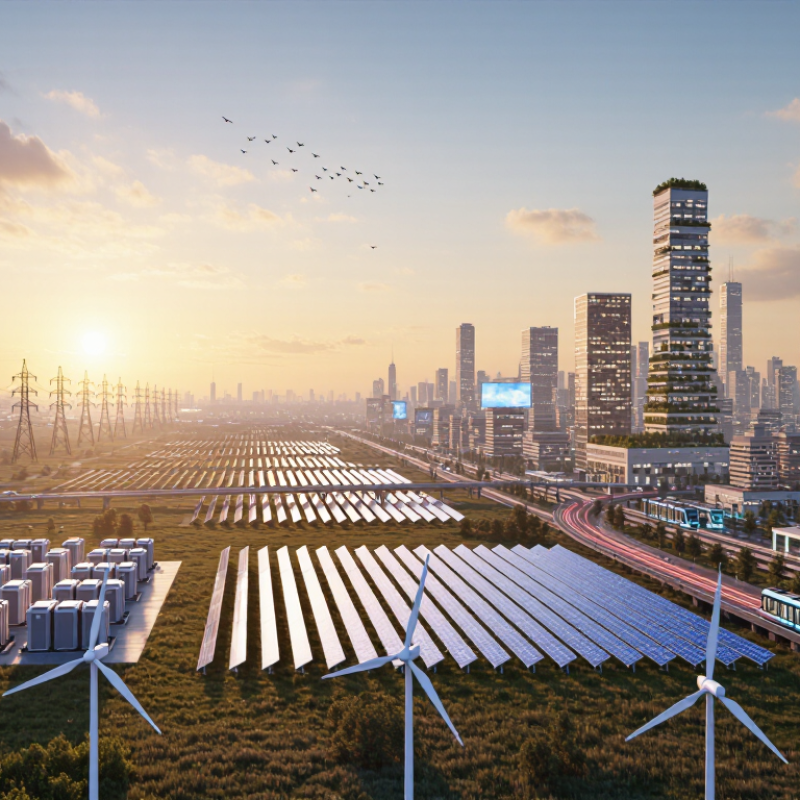
Energy production is changing at the panel, turbine, and control-room level. The IEA’s Renewables 2024 report forecasts nearly 5,500 GW of renewable power capacity additions worldwide from 2024 to 2030. That is almost three times the increase recorded during 2017–2023. Solar modules paired with tracking systems can follow the sun across a field, while digital controls help operators balance variable wind output. The forecast is striking. But new capacity does not automatically mean dependable power; connections to the grid and local conditions matter.

Storage is becoming a core part of the system, not an optional extra. The IEA’s Batteries and Secure Energy Transitions report says battery storage capacity must reach 1,200 GW by 2030 in its Net Zero Emissions scenario, roughly six times the 2022 level. At a solar site, containers of battery racks can store midday electricity and release it after sunset. Their usefulness depends on more than capacity: duration, temperature control, and the grid’s ability to absorb power all count. A target is not a deployment plan. Progress may be slower where grid upgrades and projects fall behind, a gap that headline forecasts can hide.

Major Energy Market Trends for Global Buyers

2026 Top Energy Industry Trends for Global Buyers

Global energy buyers are entering a market shaped by rising electricity demand and rapid capacity additions. The IEA’s Electricity 2025 report projects global electricity demand will grow by about 3.9% annually through 2027. This growth affects practical decisions. A factory may need dependable evening power, not merely a lower annual bill. Grid access, storage availability, and contract flexibility deserve early attention.

Renewables continue to expand, but delivery remains uneven. IRENA’s Renewable Capacity Statistics 2025 reports that renewables added 585 gigawatts in 2024, representing 92.5% of global power capacity additions. The IEA’s World Energy Investment 2025 estimates clean-energy investment at about 2.2 trillion US dollars in 2025. Buyers can compare power purchase agreements, on-site generation, and storage against local grid constraints and hourly prices. Small details matter. Ask for dated production profiles, curtailment assumptions, and clear balancing-cost estimates. Forecasts can miss; policy shifts and connection delays still change project economics. Not every low-carbon offer provides equally firm supply, so test its assumptions before committing.

How Policy and Geopolitics Shape Energy Markets

2026 Top Energy Industry Trends for Global Buyers
How Policy and Geopolitics Shape Energy Markets

Energy prices increasingly reflect policy choices as well as fuel supply. Export controls, subsidies, carbon rules, and sanctions can alter project costs before construction begins. For global buyers, a low quoted price is only one part of the calculation. Check how tariffs, local-content rules, and grid-connection delays affect delivery timelines.

The International Renewable Energy Agency reported that renewables added 585 gigawatts of capacity in 2024, representing 92.5% of global power-capacity expansion. That matters. Yet rapid deployment does not erase regional differences: permitting, transmission access, and financing costs can leave similar projects with very different schedules. Buyers should test supplier timelines against local policy and infrastructure, not just announced targets.

Geopolitics also shapes access to equipment and critical minerals. The International Energy Agency’s Global Critical Minerals Outlook 2024 found that the top three refining countries’ share across key minerals rose from about 82% in 2020 to 86% in 2023. Concentration can expose procurement to trade disputes or transport disruption. Build flexibility into sourcing plans, compare regional supply options, and review contract clauses for price adjustments. Forecasts still miss local bottlenecks; a policy announcement is not the same as a ready connection or a delivered component.

Evaluating Energy Suppliers, Costs, and Risks

For global buyers in 2026, choosing an energy supplier means looking beyond the headline rate. Compare the full cost: generation, network charges, balancing fees, taxes, and contract adjustments. Request sample invoices and ask how prices change when demand rises or market indexes move. Price is not everything. A low quote may exclude services your site depends on, such as backup capacity or clear outage support.

Check the meter. Review hourly or interval consumption data before comparing offers; a factory’s evening peaks can change which tariff is economical. Ask suppliers for recent delivery records, maintenance schedules, financial disclosures, and a named contact for disruptions. For cross-border purchases, confirm how currency movements, congestion, and local grid limits affect delivery and billing. Read termination terms carefully, especially fees and notice periods. A checklist helps, but it can still miss a weak point in a specific region. Revisit assumptions when demand, weather exposure, or infrastructure changes. No forecast is perfect; suppliers should explain what their estimate leaves out.

Contact us

Let us help you with the right solution

Address

HQ
Industrivej 10
5550 Langeskov

Talk to a consultant

Write to us to get in touch with a consultant

Address

HQ
Industrivej 10
5550 Langeskov

Thank you for your inquiry

Be contacted

Questions? Write to us and get a response

Address

HQ
Industrivej 10
5550 Langeskov

Thank you for your inquiry