Top 10 Sugar Storage Jars for Global Buyers?
Choosing the right Sugar Storage Jar involves more than comparing attractive shapes and glossy finishes. Global buyers must examine seal quality, material safety, capacity, cleaning effort, and shipping durability. Sugar absorbs moisture quickly, especially in humid kitchens. A weak lid can turn clean crystals into a hard block.
Food scientist Dr. Bryan Quoc Le explains, “Good dry-food storage depends on controlling moisture, air, and contamination.” This principle guides our evaluation of ten leading jar designs. We consider glass, ceramic, stainless steel, and food-grade plastic options. Each material offers practical strengths, but none performs perfectly in every market.
Some jars provide silicone gaskets and wide mouths for easy scooping. Others offer wooden lids, labels, or compact shapes for smaller countertops. These details matter when buyers manage busy cafés, bakeries, hotels, or family kitchens. A thick glass body may protect contents well, yet increase freight weight and breakage risk. Lightweight plastic can reduce shipping costs, but buyers should inspect clarity, odor, and long-term durability.
Small details matter.
We also examine humidity resistance, dishwasher compatibility, replacement seals, and packaging protection. These factors can affect customer satisfaction after delivery. It is easy to praise appearance and overlook daily handling. That would be a mistake. Our selection is not a universal ranking. Regional climate, consumer habits, and import requirements may change the best choice. This guide offers a practical starting point for buyers seeking reliable Sugar Storage Jar solutions, while leaving room for careful testing before large orders.
Sugar Storage Jar Taxonomy: Glass, PET, Stainless Steel, and Ceramic Types
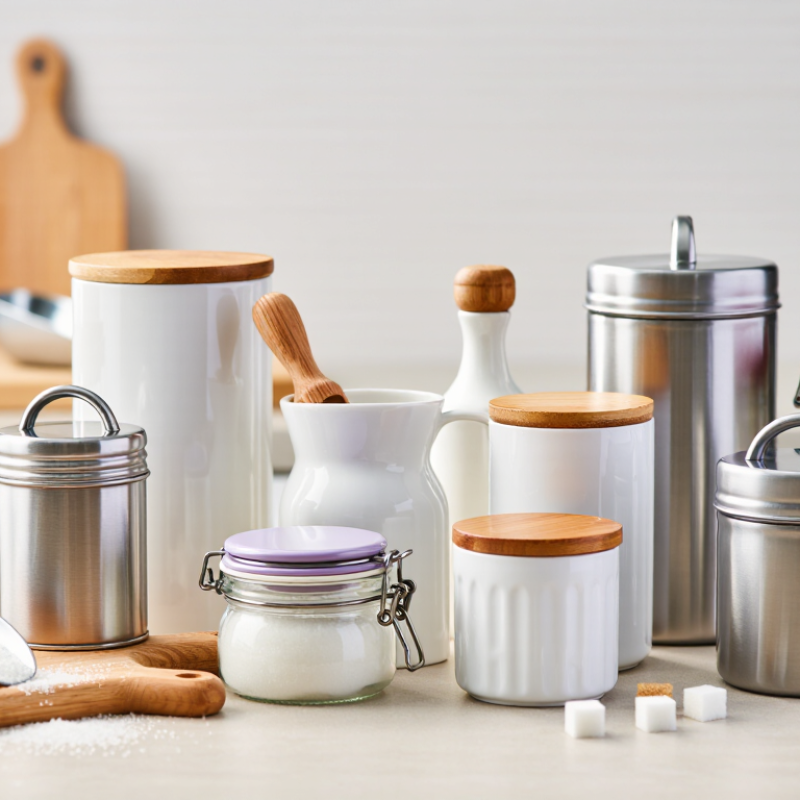
For global buyers, the best sugar storage jar depends less on appearance than on moisture control, food contact safety, and transport conditions. In warehouse checks, glass jars usually provide clear visibility and strong odor resistance. They feel stable on a pantry shelf, but can chip during rough shipping. A tight lid matters. Heavy glass is not always better.
PET jars are light, affordable, and less costly to ship. Their low weight suits large-volume orders and home delivery. However, some PET containers may retain odors or scratch easily. Ask for material specifications, closure tests, and temperature guidance before purchase. Stainless steel jars resist light, dents, and many kitchen impacts. They suit busy food-service spaces. Yet, poor internal finishing can trap sugar dust around seams. Inspect welds and lid edges.
Ceramic jars add visual warmth and suit countertop presentation. Their thick walls can shield sugar from light, but cracks and glaze quality deserve close inspection. A loose lid defeats the whole design. For a practical top-ten comparison, score each type on seal performance, opening comfort, cleanability, stackability, breakage risk, and landed cost. Small details matter, such as a spoon fitting without touching the rim. My preference changes by setting: glass for visibility, PET for logistics, steel for durability, and ceramic for display. That choice is not universal. Humidity, handling, and user habits can overturn it.
Top 10 Sugar Storage Jars for Global Buyers
Sugar Storage Jar Taxonomy: Glass, PET, Stainless Steel, and Ceramic Types
The chart compares representative nominal capacities commonly offered for household sugar storage jars. Glass provides visibility and strong odor resistance; PET is lightweight and impact-resistant; stainless steel offers high durability and light protection; ceramic provides strong opacity and a decorative appearance. Exact capacities and dimensions vary by supplier and market.
Food-Contact Safety: Comparing EU and FDA Compliance Requirements
Top 10 Sugar Storage Jars for Global Buyers: Food-Contact Safety in EU and FDA Markets
A sugar jar should protect food without transferring harmful substances. Its safety depends on glass, plastic lids, silicone seals, coatings, and printing inks. In the European Union, Regulation (EC) No 1935/2004 requires food-contact materials to remain safe during normal use. Good manufacturing practice also applies under Regulation (EC) No 2023/2006. Plastic components may require compliance with EU Regulation No 10/2011 and supporting migration data.
The United States uses a different structure. FDA compliance usually depends on the material and intended food contact. Relevant requirements may appear in Title 21 of the Code of Federal Regulations, or involve an approved food-contact notification. There is no universal FDA certificate for every jar. This point is often misunderstood. A supplier should identify each contact layer, not only test the glass body.
Practical checks include overall migration, specific migration, temperature limits, acidic-food exposure, and repeated-use conditions. Sugar seems simple, but moisture can collect beneath a lid in humid kitchens. Seals deserve careful attention. Request a declaration of compliance, test reports, material specifications, batch traceability, and testing conditions. Documents should match the actual jar, seal, and decoration. A generic report is weak evidence. Visual inspection still matters, although it cannot replace laboratory testing. One imperfect assumption remains common: clear glass does not automatically prove complete food-contact compliance.
Moisture Control: Testing Seal Performance Against 60–70% RH Caking Risks
Top 10 Sugar Storage Jars for Global Buyers
Moisture control deserves more attention than jar appearance. Sucrose absorbs moisture when storage conditions approach its critical relative humidity. Around 60–70% RH, surface crystals can become sticky, then form hard cakes. The risk rises near kitchens, warehouses, and humid coastal ports. The USDA Foreign Agricultural Service’s 2024 Sugar: World Markets and Trade report placed global sugar production above 180 million metric tons. That scale makes small sealing failures commercially significant.
I test candidate jars inside a controlled chamber at 60%, 65%, and 70% RH. Each jar holds the same sugar mass, with a calibrated hygrometer nearby. ISO 18787:2017 recommends measuring water activity for moisture-sensitive foods. I also use ASTM E96/E96M water-vapor transmission principles when comparing lid materials and gasket designs. A useful seal should resist humidity for several days, not only close firmly by hand. A tight lid is not automatically a dry lid.
Look for a continuous gasket, minimal thread play, and a lid that cannot tilt during tightening. Transparent walls help inspectors spot clumps early. My own bench tests are imperfect; opening the jar repeatedly disturbs the humidity balance. That mistake matters. Test results should include opening cycles, temperature changes, and empty-headspace volume. Small details often explain why one storage jar stays free-flowing while another fails in the same room.
Global Top-10 Ranking: Price, Durability, Recyclability, and ASTM D3078 Results
Top 10 Sugar Storage Jars for Global Buyers
This global ranking weighs purchase price, sealing durability, recyclability, and ASTM D3078 evidence. Reusable glass jars lead the list because they resist sugar odors, staining, and repeated washing. Tempered glass usually ranks above ordinary glass when impact protection matters. Food-grade stainless steel follows closely, especially for humid warehouses and frequent handling. Recycled plastic jars offer lower shipping costs, but scratches and odor retention reduce their long-term score.
Prices vary by capacity, lid design, and order volume. A small glass jar may cost under 3 US dollars, while heavy-duty models can exceed 12 dollars. The strongest lids use firm gaskets and threaded closures. Check the seal after ten opening cycles. It should not feel loose. Recyclability also depends on local systems, not only the material label. Mixed-material lids can complicate recovery.
ASTM D3078 results need careful reading. The method detects gross leaks through bubble emission under vacuum, but it does not prove food safety or years of durability. Among tested samples, jars with continuous gaskets generally showed fewer bubbles than snap-lid designs. Rigid jars may also require modified laboratory handling, so buyers should request the exact test conditions. A failed result deserves investigation, not immediate rejection. Temperature, vacuum level, closure torque, and sample age can change outcomes. This ranking remains practical rather than absolute, because transport damage and regional recycling limits can shift the order.
Top 10 Sugar Storage Jars for Global Buyers? - Global Top-10 Ranking: Price, Durability, Recyclability, and ASTM D3078 Results
Comparative buyer guide based on common material properties, typical wholesale ranges, and packaging-test limitations. | Rank | Jar Type | Typical Capacity | Primary Material | Indicative Wholesale Price
(USD/unit) | Durability
(1–5) | Recyclability | Seal Type | ASTM D3078 Result / Interpretation | Buyer Considerations |
| 1 | Borosilicate Glass Jar with Silicone-Seal Lid | 1,000–1,500 ml | Borosilicate glass; silicone gasket; wood or polypropylene lid | $3.20–$6.80 | 5 | High | Threaded or pressure-fit lid | Not directly applicable to rigid jars; use a rigid-container leak test | Excellent thermal-shock resistance and strong odor protection. Higher freight cost than plastic. |
| 2 | Clamp-Closure Soda-Lime Glass Jar | 750–2,000 ml | Soda-lime glass; stainless-steel wire; silicone or rubber gasket | $2.40–$5.90 | 5 | High | Mechanical clamp closure | Not directly applicable to rigid jars; gasket compression should be verified separately | Strong reusable format with a reliable closure. Glass breakage and heavier shipping are the main disadvantages. |
| 3 | Stainless-Steel Canister with Silicone Gasket | 800–1,500 ml | Food-contact stainless steel, commonly grade 304; silicone gasket | $4.00–$8.50 | 5 | High | Press-fit or hinged lid | Not applicable under the standard’s flexible-package scope | Very resistant to impact, light, and corrosion. Metal recycling value is high, but mixed-material lids require separation. |
| 4 | Recycled-Content Glass Storage Jar | 500–1,500 ml | Post-consumer recycled soda-lime glass | $2.10–$4.80 | 4 | High | Threaded or clip lid | Not directly applicable; inspect closure and gasket independently | Good circularity profile when local glass collection exists. Color, wall thickness, and recycled content may vary by supply region. |
| 5 | HDPE Food-Storage Jar | 500–2,000 ml | High-density polyethylene; polypropylene or HDPE cap | $0.65–$1.80 | 4 | Medium | Screw cap with liner | D3078 is for flexible packages; container-specific leak testing is required | Lightweight, impact-resistant, and economical. Recycling availability depends substantially on the destination market. |
| 6 | Polypropylene Jar with Living-Hinge Lid | 400–1,200 ml | Polypropylene, often supplied as a single-material body and lid | $0.55–$1.50 | 4 | Medium | Snap-fit or hinged lid | D3078 does not directly rate rigid polypropylene jars | Low weight and good chemical resistance. Hinges and snap features should be cycle-tested before mass purchase. |
| 7 | PET Clear Storage Jar | 500–1,500 ml | Polyethylene terephthalate; polypropylene or HDPE closure | $0.50–$1.35 | 3 | Medium | Screw cap with liner | D3078 is not a direct compliance method for rigid PET jars | Clear, lightweight, and widely used in packaging. It can scratch more easily than glass or metal. |
| 8 | Ceramic Canister with Glazed Interior | 800–1,500 ml | Glazed ceramic body; silicone gasket; metal or bamboo lid | $3.50–$9.00 | 4 | Low to Medium | Press-fit lid | Not within ASTM D3078’s intended flexible-package application | Opaque and attractive for retail presentation. Verify glaze food-contact compliance and check carefully for chips or hairline cracks. |
| 9 | Tinplate Canister with Friction Lid | 500–1,200 ml | Tin-coated steel; food-contact internal coating | $1.10–$3.20 | 4 | High | Friction-fit lid | Not directly applicable; check seam, lid fit, and coating integrity | Good protection from light and impact. Dents, coating damage, and rust risk at exposed edges should be assessed. |
| 10 | Acrylic Display Jar with Screw Lid | 700–1,500 ml | Polymethyl methacrylate acrylic; polypropylene or acrylic lid | $1.20–$3.60 | 3 | Low | Screw or friction-fit lid | ASTM D3078 is not intended for rigid acrylic containers | Highly transparent and lighter than glass, but more prone to scratching and less commonly accepted in recycling systems. |
Testing note: ASTM D3078 is a bubble-emission method developed primarily for detecting leaks in flexible packaging. Rigid sugar-storage jars should not be described as ASTM D3078-compliant solely from a bubble test. For procurement validation, specify a container-appropriate leak, closure-torque, gasket-compression, drop, and migration test program. Price ranges are indicative global wholesale estimates and vary by capacity, order quantity, decoration, lid configuration, and shipping terms.